
01
Material Behavior
Understand compression, recovery, thermal response and how material properties affect forming.
Powder compacting is a forming process in which dry powder is placed into a mold cavity and compressed under controlled pressure to produce a shaped and compacted part. The powder is distributed into the mold according to the required product shape and filling volume. A hydraulic press then applies…
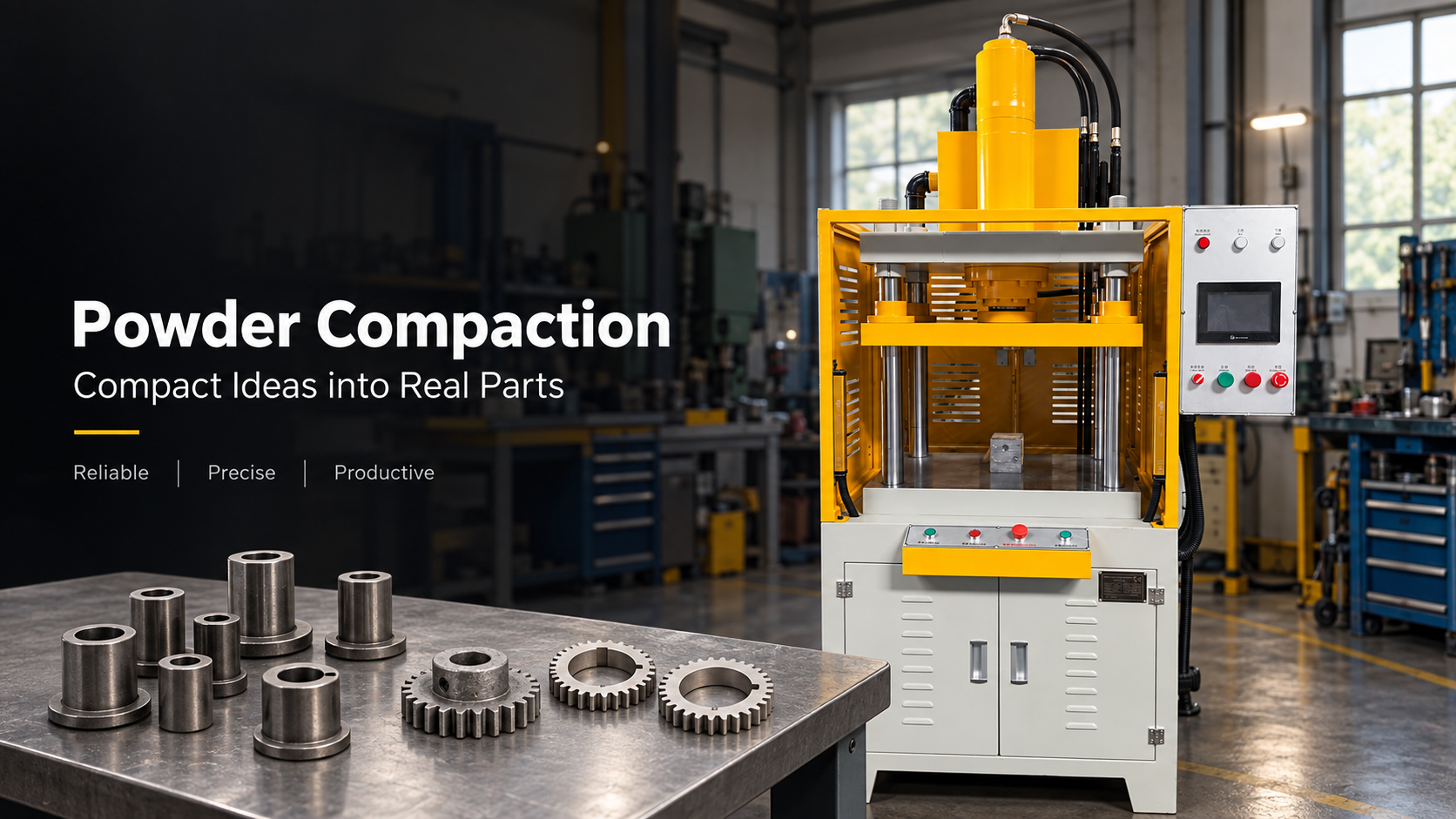
Powder compacting is a forming process in which dry powder is placed into a mold cavity and compressed under controlled pressure to produce a shaped and compacted part.
The powder is distributed into the mold according to the required product shape and filling volume. A hydraulic press then applies controlled pressure through the mold and punches to compact the powder and achieve the required shape, dimensions and density.
The compacted part can then be removed from the mold for subsequent processes such as sintering, heat treatment or other finishing operations, depending on the material and application.
Identify the material structure, thickness, thermal behavior and compression characteristics.
Evaluate heating or cooling, pressure, holding time and mold requirements.
Determine press force, working area, stroke, opening and hydraulic control requirements.
Discuss cycle time, capacity, automation, repeatability and testing requirements.
The engineering review connects material behavior, forming conditions, tooling, machine structure, production capacity and agreed verification requirements.
Understand compression, recovery, thermal response and how material properties affect forming.
Determine whether preheating, heating, cooling or separate processing stages are required.
Discuss applied force, pressure build-up, holding time and repeatability.
Review mold dimensions, working area, stroke, opening height and demolding.
Evaluate production volume, loading, transfer time and automation requirements.
Agree on process parameters, inspection methods and equipment testing requirements.
Send us the product drawing, material specifications, mold details and production output requirements.
We can discuss the forming process, press configuration and supporting equipment appropriate for your manufacturing application.