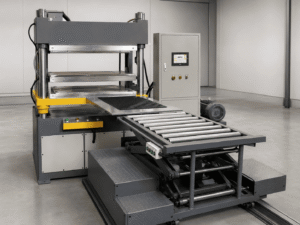
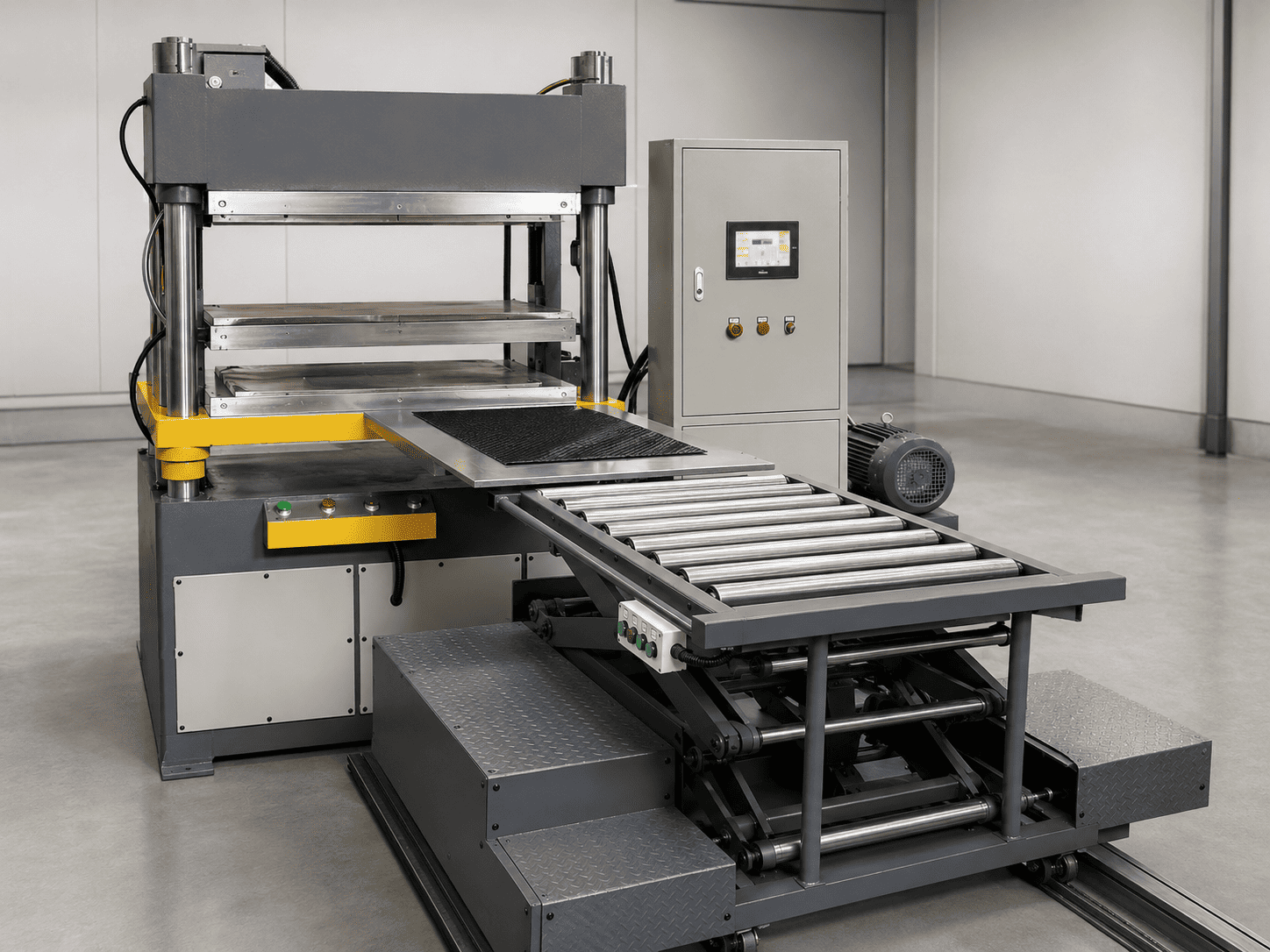
Carbon fiber sheets from prepreg require much more control than simply placing stacked material inside a hot press. Poor layup, uneven pressure, or an unsuitable thermal cycle can lead to rejected parts and inconsistent production. I approach the process by matching the material, sheet specification, tooling, and quality targets with the complete press system.
Carbon fiber sheets from prepreg are made by cutting and stacking prepreg plies, loading the layup into suitable tooling, applying controlled heat and pressure, curing according to the material supplier’s process window, cooling under defined conditions, and then demolding, trimming, and inspecting the sheet. Manufacturers must validate every major parameter through supplier documentation and process trials.
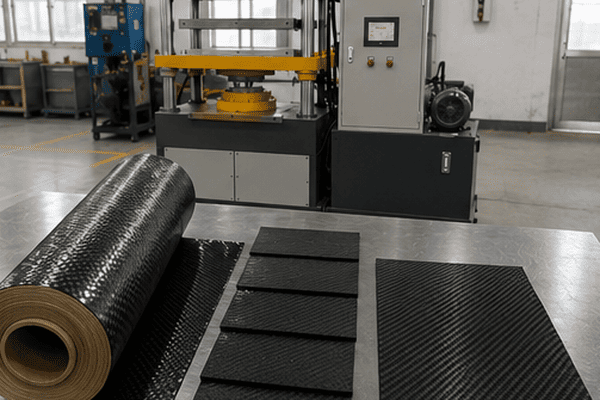
That sequence appears straightforward, but each stage creates an equipment decision. From a press-system perspective, I need to understand sheet dimensions, layup, thermal requirements, pressure distribution, production volume, and allowable variation before I can judge whether a hot press is suitable.
How Are Carbon Fiber Sheets from Prepreg Manufactured Step by Step?
A simple process diagram can hide several failure points. If a manufacturer treats cutting, layup, curing, and cooling as unrelated operations, small variations can accumulate into thickness inconsistency, warpage, surface defects, or longer cycles. I therefore evaluate the process as one connected manufacturing system.
Carbon fiber sheets from prepreg generally pass through seven stages: material preparation, ply cutting, layup, mold loading, controlled heating and pressing, controlled cooling, and final inspection. Each stage must follow the prepreg supplier’s guidance and the sheet’s engineering requirements. Qualified composite-process personnel should validate the final production method.
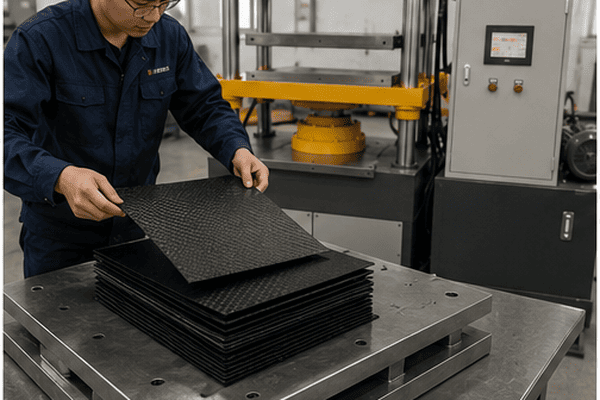
1. Store and prepare the prepreg
Prepreg contains reinforcing carbon fibers that have already been impregnated with a controlled resin system. The material supplier normally specifies refrigerated storage conditions, out-time limits, handling requirements, shelf life, and curing guidance.
I recommend that buyers begin with the current material technical data sheet and processing instructions. Those documents help the production team define:
- Required storage and thawing procedures
- Allowable exposure time outside controlled storage
- Recommended cure temperature range
- Typical pressure or consolidation guidance
- Heating and cooling limitations
- Handling and safety precautions
The production team should record material batch numbers and relevant handling times. This traceability helps separate material variation from equipment or operator variation during process development.
2. Cut the prepreg plies
The operator or automated cutting system cuts the prepreg into the required ply shapes. Fiber orientation matters because the stacking sequence influences the finished sheet’s directional behavior.[^1]
A laminate may use plies arranged at orientations such as 0°, 90°, or selected angles. However, the laminate designer must determine the actual sequence according to the required mechanical performance. I do not treat one layup pattern as suitable for every carbon-fiber sheet.
Cutting quality also affects production. Inconsistent ply dimensions, contamination, damaged edges, or inaccurate fiber orientation can create problems that the press cannot correct later.[^2]
3. Build the layup
The production team stacks the cut plies in the specified order. The team must control alignment, cleanliness, ply count, and trapped air as far as the approved process requires.
For flat sheets, the tooling arrangement may include:
- A lower mold or flat tool plate
- An upper tool plate or mold
- Release film or another specified release system
- Edge stops or locating features
- Caul plates, spacers, or thickness-control features
- A defined loading method for multiple sheets per cycle
I often ask how operators will assemble and transfer the layup. A theoretically correct press cycle can still produce variation when the loading method changes from operator to operator.
4. Load the mold and apply the approved cycle
The loaded tool enters the hot press, where the system applies a controlled combination of heat and force. The exact sequence depends on the resin system, laminate construction, tooling, and target sheet properties.
The process may require pressure to begin at a specific stage rather than at the maximum level immediately. Likewise, the system may need to follow a defined heating ramp, hold period, or staged cycle. The material supplier and the process engineer should establish these details through documented evaluation.
5. Cure and cool the laminate
During curing, the resin changes and consolidates the laminate under the defined conditions. The press must maintain the required force and thermal control throughout the relevant process stages.
Cooling also needs careful planning. Some processes require cooling while the sheet remains under pressure. Others use a separate cooling station or a hot-and-cold press arrangement. The correct approach depends on cycle-time goals, tooling, material guidance, and warpage requirements.
6. Demold, trim, and inspect
After the laminate reaches the approved release condition, the operator removes it from the tool. The sheet may then require trimming, edge finishing, cleaning, or machining.
The quality team should inspect characteristics that relate to the purchase specification, such as:
- Length, width, and thickness
- Thickness variation across the sheet
- Flatness or allowable warpage
- Surface appearance
- Edge condition
- Visible defects
- Laminate integrity
- Application-specific mechanical properties
The manufacturer should define test methods and acceptance limits before equipment procurement. A press supplier can support equipment configuration, but qualified composite and quality professionals must establish whether the finished sheet meets its intended application.
Which Process Parameters Control Carbon Fiber Sheets from Prepreg?
Manufacturers sometimes ask me for one temperature, pressure, and dwell-time recipe. That request creates risk because prepregs use different resin chemistries and reinforcement constructions. A copied setting may fall outside the approved process window, even when two materials look similar.
The main process variables are the layup, temperature profile, applied pressure, dwell time, heating rate, cooling rate, tooling arrangement, and material handling history. Manufacturers should obtain starting parameters from the prepreg supplier and then verify them through controlled trials using the actual sheet size, construction, mold, and production equipment.
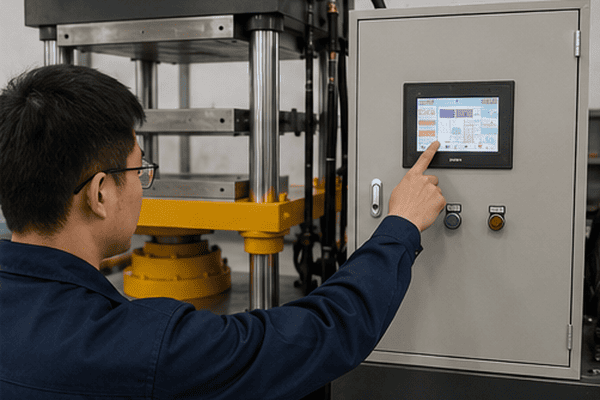
Why no universal cure recipe exists
Different prepreg systems can have different flow, cure, storage, and handling characteristics.[^3] Sheet thickness also changes how quickly heat reaches the laminate’s center.[^4] In addition, a thin test coupon and a large production sheet may respond differently because their thermal mass and heat-transfer paths differ.
I therefore avoid presenting a single fixed combination of temperature, pressure, and time. Instead, I suggest building a controlled process window around verified material guidance.
| Process variable | Why it matters | What the manufacturer should verify |
|---|---|---|
| Prepreg system | Resin behavior determines the approved processing window | Current supplier data sheet and batch information |
| Layup and ply count | Construction affects thickness and heat transfer | Engineering drawing and laminate schedule |
| Tool temperature | Tool temperature may differ from displayed platen temperature | Calibrated tool or embedded temperature measurement |
| Pressure or force | Consolidation depends on actual loaded area and tooling | Required pressure profile and force calculation |
| Heating rate | Rapid or slow heating can change process behavior | Supplier guidance and production trials |
| Dwell time | The laminate needs the validated exposure at process conditions | Time definition and sensor location |
| Cooling method | Cooling can influence cycle time and dimensional stability | Release condition and cooling-under-pressure needs |
| Material out-time | Handling history can affect consistency | Storage and production records |
Pressure is not the same as press tonnage
I often see procurement discussions begin with a tonnage request. However, a press rating alone does not show the actual pressure applied to the laminate.
The basic relationship is:
> Required force = target pressure × effective loaded area
The engineering team must use consistent units and define the correct effective area. Tool geometry, cavities, multiple-up loading, spacers, and load paths can affect that calculation. The team should also include a justified operating margin without assuming that a much larger press automatically creates better parts.
For example, two manufacturers may use the same nominal sheet dimensions but require different press configurations because one loads a single mold while the other loads several tools per cycle.
Actual material temperature deserves attention
A platen setpoint does not automatically equal the temperature inside the laminate.[^5] Heat must travel through the platen, tool, release layers, and layup. Tool thickness and material can change the response.
During process development, I recommend comparing:
- Controller temperature
- Platen temperature at multiple positions
- Tool-surface temperature
- Internal laminate temperature, where appropriate
- Heating time under realistic loading
- Cooling time before release
Qualified personnel should select and place sensors correctly. The team should also calibrate measurement devices and document the test arrangement. This work turns a nominal machine setting into a repeatable production process.
Why Is Press Tonnage Alone Inadequate for Prepreg Carbon Fiber Sheets?
A press can have enough nominal force and still be unsuitable for a specific sheet. An undersized platen, poor temperature uniformity, excessive deflection, or insufficient cooling capacity can limit production. I therefore treat tonnage as only one item in a broader technical review.
Carbon fiber sheets from prepreg require a press that matches the loaded area, force requirement, platen dimensions, temperature uniformity, pressure distribution, parallelism, opening, stroke, control accuracy, tooling, and heating or cooling demand. Buyers should evaluate these factors under realistic production loading rather than compare nominal tonnage alone.
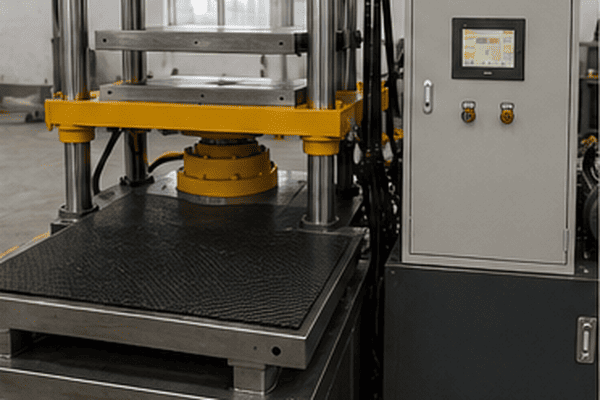
Usable platen area
The platen must accommodate more than the nominal finished-sheet dimensions. The supplier needs to consider the mold footprint, locating devices, edge structures, insulation, piping, clamps, and operator access.
I ask buyers to provide both the finished sheet size and the complete mold dimensions. Those numbers are not interchangeable. A sheet that measures 1,000 × 500 mm, for example, may require a significantly larger platen after the tooling arrangement is included.
Pressure distribution and structural rigidity
The machine frame, cylinder arrangement, moving platen, and tooling all contribute to the loaded system. If the structure deflects excessively or the tool receives an uneven load, the finished sheet may not maintain the required thickness distribution.[^6]
However, the press alone does not determine thickness consistency. Ply preparation, material condition, tool design, spacers, release layers, and process timing also contribute. I prefer to review the complete stack rather than assign every variation to the hydraulic system.
Platen temperature uniformity
Large platen surfaces can develop temperature differences if the heater layout, oil channels, zoning, insulation, or control strategy does not match the application. Manufacturers should define a measurable uniformity requirement and an agreed test method.
A useful procurement specification should state:
- Test temperature or operating range
- Measurement grid and sensor type
- Stabilization conditions
- Whether the test uses an empty or loaded platen
- Acceptable variation
- Calibration requirements
- Reporting format
Buyers should avoid accepting an isolated temperature reading as proof of uniformity across the usable area.
Opening, daylight, and stroke
The press needs enough opening for the tool stack, loading method, part removal, and any transfer equipment. The required daylight can increase when the line uses several molds, mobile tables, insulation plates, or automated handling.
Stroke also influences operating time. A machine with unnecessary travel may increase non-processing movement, while insufficient travel can make loading impractical. I usually discuss the loading sequence before confirming these dimensions.
Heating and cooling capacity
A heater rating alone does not establish cycle performance. The system must heat the platen, mold, and material within the required process profile. The design also needs to account for heat losses and repeated cycles.
The same principle applies to cooling. The engineering review should consider:
- Water supply temperature and flow
- Chiller capacity
- Cooling-channel arrangement
- Heat-exchanger sizing
- Mold thermal mass
- Target release condition
- Cycles per shift
- Ambient operating conditions
In one equipment-selection discussion, I found that the initial request focused almost entirely on press force. After we reviewed the desired cycle, cooling became an equally important system constraint. That experience reinforced a practical lesson: throughput depends on the whole thermal cycle, not only the pressing stage.
How Should Buyers Specify Equipment for Carbon Fiber Sheets from Prepreg?
An incomplete request for quotation usually produces proposals that are difficult to compare. If a buyer provides only tonnage and platen size, each supplier may assume a different mold, cycle, or loading method. I recommend preparing a process-based specification before requesting commercial offers.
Buyers should specify the sheet dimensions, thickness range, layup, mold size, number of sheets per cycle, target cycle time, material requirements, heating and cooling method, thickness tolerance, allowable warpage, surface expectations, utilities, and automation level. Suppliers should identify their assumptions and explain how the proposed system addresses each requirement.
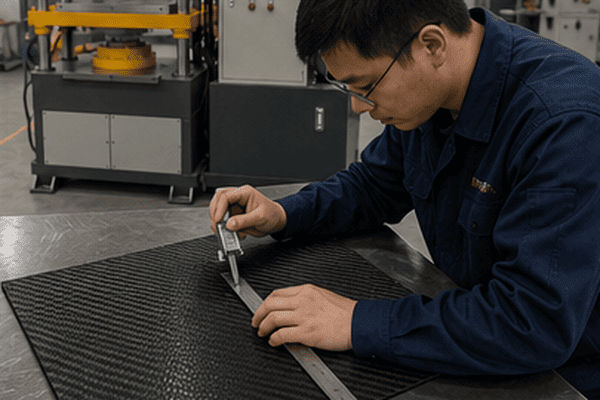
Information to prepare before contacting suppliers
I use the following questions during early equipment discussions:
- What are the finished sheet length, width, and thickness?
- What are the minimum and maximum product sizes?
- Which prepreg system will the factory process?
- What layup and ply-count range will production use?
- What are the complete mold dimensions and weight?
- How many sheets or molds must run in each cycle?
- What cycle time and daily output does the factory target?
- Does the process require heating, cooling, or both under pressure?
- What thickness tolerance and flatness requirement apply?
- What surface-quality standard must the sheet meet?
- How will operators load and unload the tooling?
- Does the factory need manual, semi-automatic, or automatic handling?
These answers help a supplier calculate force, size the platens, estimate thermal demand, define the opening, and propose an appropriate control system.
Compare technical proposals on the same basis
I recommend using a comparison matrix rather than comparing only the quoted price.
| Evaluation item | Questions for the supplier |
|---|---|
| Force capacity | How was the required force calculated from the loaded area? |
| Platen dimensions | Do the dimensions include the complete tooling footprint? |
| Temperature performance | What uniformity is specified, and how will the supplier test it? |
| Hydraulic control | How does the system regulate force or pressure during the cycle? |
| Parallelism | What is specified, and under which measurement conditions? |
| Heating system | What type, capacity, zoning, and control method are proposed? |
| Cooling system | Is cooling integrated, external, or handled in another station? |
| Cycle control | Can the controller store and track validated process recipes? |
| Data records | Which temperatures, pressures, alarms, and cycle data can it log? |
| Safety | Which guarding, interlocks, and emergency functions are included? |
| Acceptance testing | Which tests will occur before shipment and after installation? |
| Support | Who handles commissioning, training, spare parts, and maintenance? |
Review the supplier’s assumptions
A technically serious supplier should state what it knows and what still requires confirmation. I become cautious when a proposal promises finished-sheet quality without reviewing the prepreg data, layup, tool design, and acceptance criteria.
The buyer should request drawings and documents that apply to the project. Depending on the machine and destination market, these may include:
- General arrangement drawings
- Hydraulic and electrical schematics
- Component lists
- Utility requirements
- Operating and maintenance manuals
- Inspection and calibration records
- Risk-assessment documentation
- Applicable declarations or certificates
- Factory acceptance test procedures
Buyers should verify certifications and compliance documents with the issuing body or a qualified specialist. A logo in a brochure does not by itself prove that a specific machine complies with the rules applicable at the installation site.
Define acceptance tests before ordering
The purchase contract should define what the supplier must demonstrate. I recommend linking acceptance tests to measurable equipment requirements rather than expecting the machinery supplier to guarantee every finished-material property.
A factory acceptance test may review:
- Machine dimensions and opening
- No-load and controlled-load operation
- Force or pressure control
- Platen movement and parallelism
- Temperature rise and stability
- Temperature uniformity under agreed conditions
- Cooling operation
- Recipe functions and data logging
- Alarm and safety functions
- Repeated automatic cycles
Product trials can also be valuable, but all parties should agree on the material, tooling, preparation method, inspection procedure, and acceptance limits. The prepreg supplier, composite-process engineer, mold designer, equipment manufacturer, and end user may all need to participate in application-specific validation.
Frequently Asked Questions
Can any hot press make carbon fiber sheets from prepreg?
No. The press must provide the required platen area, force, temperature control, pressure distribution, parallelism, opening, and thermal capacity. The complete system must also suit the mold, loading method, cycle, and quality targets. Buyers should verify suitability through a technical review and representative process trials.
What temperature is required to cure prepreg carbon fiber sheets?
No single temperature applies to every prepreg. The required cure profile depends on the resin system and material supplier’s instructions. Manufacturers should use the current technical data sheet as a starting point and validate the actual laminate temperature, heating profile, dwell, and cooling conditions through qualified process trials.
How do I calculate the required hot-press tonnage?
The engineering team generally calculates required force by multiplying the validated process pressure by the effective loaded area. The team must use consistent units and account for the real tooling arrangement. A qualified press supplier should also review structural capacity, load distribution, operating margins, and multiple-mold loading.
Does higher pressure always improve carbon-fiber sheet quality?
No. Excessive or incorrectly timed pressure can be as unsuitable as insufficient pressure.[^7] The correct pressure profile depends on the prepreg, layup, resin behavior, tooling, and target laminate. Manufacturers should follow material guidance and validate the process rather than assume that more press force produces better sheets.
Should carbon-fiber sheets cool inside the press?
Some processes require controlled cooling while pressure remains applied, while others may use a separate cooling press or station. The suitable method depends on the prepreg system, tool design, release condition, dimensional requirements, and cycle target. Manufacturers should confirm the method with qualified process specialists before selecting equipment.
Conclusion
Carbon fiber sheets from prepreg result from a connected sequence of material preparation, accurate layup, controlled heating and pressing, validated curing, managed cooling, and inspection. I never recommend selecting a hot press by tonnage alone because platen area, uniformity, parallelism, controls, tooling, and thermal capacity can be equally important. Material suppliers and qualified composite professionals should validate the application-specific process. If you are planning a new sheet line, contact Huajia Hydraulic with your product dimensions, mold details, cycle target, and quality requirements so our team can evaluate an appropriate press-system configuration.
[^1]: "(PDF) Investigation of the Effect of Fiber Orientation on Mechanical ...", https://www.academia.edu/79846424/Investigation_of_the_Effect_of_Fiber_Orientation_on_Mechanical_Properties_of_Composite_Laminate_Using_Numerical_Analysis. Classical laminate theory and experimental composites literature show that ply orientation and stacking sequence govern the anisotropic stiffness and load response of laminated fiber-reinforced composites. Evidence role: mechanism; source type: education. Supports: A laminate-mechanics source should explain that changing ply angles and stacking sequence changes laminate stiffness, strength, coupling, and other directional responses.. Scope note: The resulting properties also depend on constituent materials, fiber volume fraction, defects, geometry, and loading conditions. [^2]: "Advanced Composites Project Publications - NASA", https://www.nasa.gov/directorates/armd/aavp/ac/advanced-composites-project-publications/. Composite-manufacturing studies identify ply misalignment, foreign-material contamination, wrinkles, gaps, and edge defects as process-induced conditions that may remain after cure and reduce laminate quality or performance. Evidence role: general_support; source type: paper. Supports: A review or experimental study should establish that ply misalignment, contamination, dimensional errors, and related layup defects can persist through cure and affect laminate integrity or mechanical performance.. Scope note: The severity of a given defect depends on its type, size, location, laminate design, and service loading. [^3]: "Modeling of Cure Kinetics and Rheological Behavior of ... - PMC", https://pmc.ncbi.nlm.nih.gov/articles/PMC12943695/. Published studies of prepreg resin systems show formulation-dependent differences in viscosity evolution, cure kinetics, tack, storage stability, and recommended processing conditions. Evidence role: expert_consensus; source type: paper. Supports: A review should show that prepreg formulations exhibit different viscosity profiles, reaction kinetics, handling behavior, and storage requirements.. Scope note: General comparisons cannot establish the correct cycle for a particular commercial prepreg; product-specific data and validation remain necessary. [^4]: "[PDF] Through Thickness Thermal Gradients in Thick Laminates During ...", https://ntrs.nasa.gov/api/citations/20190000476/downloads/20190000476.pdf. Heat-transfer and cure-simulation studies show that increasing laminate thickness changes centerline heating and can produce substantial through-thickness temperature and degree-of-cure gradients. Evidence role: mechanism; source type: paper. Supports: A thermal-modeling or experimental source should demonstrate that laminate thickness and thermal properties affect centerline heating and through-thickness temperature gradients.. Scope note: The magnitude and direction of these gradients also depend on tool contact, boundary conditions, heating rate, resin exotherm, and laminate thermal properties. [^5]: "Hot-Pressing Process of Flat-Pressed Wood–Polymer ... - PMC", https://pmc.ncbi.nlm.nih.gov/articles/PMC11510764/. Experimental and modeled cure studies distinguish equipment setpoint from tool and laminate temperature because heat-transfer resistance, thermal mass, and resin exotherm can produce time-dependent temperature differences within the processing stack. Evidence role: mechanism; source type: paper. Supports: A source should document thermal lag and temperature differences among heaters, platens, tools, and laminate interiors during composite cure.. Scope note: The size of the difference is specific to the press, tooling, sensor placement, layup, and cycle. [^6]: "Effect of Thickness on the Uniaxial Compression Failure ...", https://pmc.ncbi.nlm.nih.gov/articles/PMC12473190/. Studies of composite consolidation and compression molding show that spatial variations in tool pressure or structural deflection can produce nonuniform compaction, resin redistribution, and final thickness. Evidence role: mechanism; source type: paper. Supports: A study should connect nonuniform pressure or platen/tool deflection with differences in compaction, resin flow, fiber volume fraction, or final laminate thickness.. Scope note: Observed thickness variation may also arise from ply-count errors, material variability, local fiber architecture, spacers, release layers, or cure timing. [^7]: "Research on Modeling for the Flow–Compaction Process of ...", https://pmc.ncbi.nlm.nih.gov/articles/PMC11946475/. Prepreg-consolidation research shows that pressure interacts with the resin-viscosity cycle: insufficient pressure may leave poor interply contact or voids, whereas excessive or mistimed pressure can promote resin squeeze-out, fiber displacement, or unintended changes in fiber volume fraction. Evidence role: mechanism; source type: paper. Supports: A processing study should show that consolidation pressure interacts with resin viscosity and timing and that inappropriate pressure can cause excessive resin flow, fiber movement, or other defects.. Scope note: The acceptable pressure magnitude and timing are specific to the resin system, reinforcement architecture, tooling, bleed arrangement, and target laminate.